
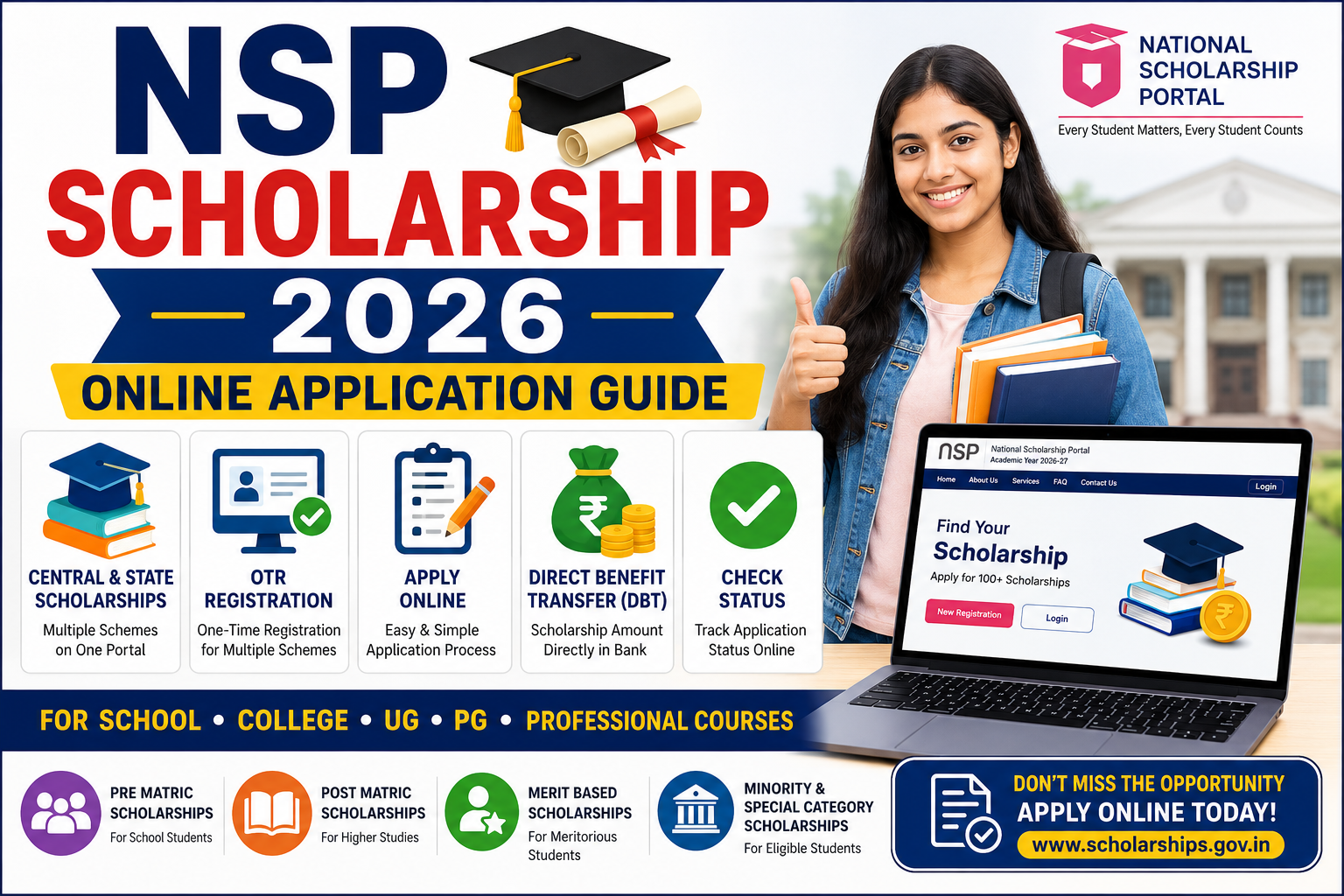
NSP Scholarship 2026
Education is one of the most valuable investments for a student’s future, but the rising cost of tuition fees, books, accommodation, and other educational expenses can make higher education difficult for many families. To help deserving students continue their education without financial hardship, the Government of India provides numerous scholarship schemes through the National Scholarship Portal (NSP).
The National Scholarship Portal (NSP) is a centralized online platform where students can apply for various Central Government scholarship schemes, State Government scholarships, UGC scholarships, AICTE scholarships, and other eligible scholarship programs using a single portal. It simplifies the entire process—from registration and application submission to verification, status tracking, and scholarship disbursement. (India.gov.in)
If you’re planning to apply for the NSP Scholarship 2026, this guide explains everything you need to know, including eligibility, One-Time Registration (OTR), required documents, online application process, renewal, scholarship status, and important tips to avoid application rejection.
NSP Scholarship 2026 – Overview
| Particular | Details |
|---|---|
| Scholarship Portal | National Scholarship Portal (NSP) |
| Managed By | Government of India |
| Purpose | Online Scholarship Application & Management |
| Beneficiaries | Eligible School, College, UG, PG & Professional Course Students |
| Registration | One-Time Registration (OTR) |
| Application Mode | Online |
| Scholarship Types | Central, State, UGC, AICTE & Other Schemes |
| Payment Mode | Direct Benefit Transfer (DBT) |
| Official Portal | National Scholarship Portal |
What is the National Scholarship Portal (NSP)?
The National Scholarship Portal is a digital platform developed by the Government of India to bring multiple scholarship schemes under one system.
Instead of visiting different departmental websites, eligible students can register once, explore available scholarship schemes, submit applications online, upload documents, track application status, and monitor scholarship payments through a single portal. (India.gov.in)
Objectives of NSP
The National Scholarship Portal aims to:
- Make scholarship applications completely online.
- Improve transparency in scholarship distribution.
- Reduce paperwork.
- Minimize duplicate applications.
- Enable Direct Benefit Transfer (DBT).
- Allow students to track applications online.
- Simplify verification for institutes and authorities.
Major Benefits of NSP Scholarship
Students applying through NSP enjoy several advantages:
Single Portal
Multiple scholarship schemes are available through one platform.
One-Time Registration (OTR)
Students create one permanent OTR that can be used throughout their academic career on NSP. (India.gov.in)
Online Application
No need to visit multiple offices for submitting scholarship forms.
Transparent Verification
Applications move through institute, district, state, and ministry verification wherever applicable.
Direct Bank Transfer
Approved scholarship amounts are generally transferred directly to the beneficiary’s bank account through DBT.
Online Status Tracking
Applicants can monitor every stage of their application online.
Types of Scholarships Available on NSP
The portal hosts different categories of scholarship schemes, such as:
Central Sector Scholarships
Scholarships funded by various Central Government Ministries.
UGC Scholarships
Scholarships administered through the University Grants Commission.
AICTE Scholarships
Financial assistance for eligible technical education students.
State Government Scholarships
Many states integrate their scholarship schemes with NSP or use linked systems.
Minority Scholarships
Eligible students belonging to notified minority communities may apply for applicable schemes.
Pre-Matric Scholarships
Designed for eligible students studying at the school level.
Post-Matric Scholarships
Available for eligible students pursuing education after Class 10.
Merit-Based Scholarships
Awarded under specific schemes based on academic performance and eligibility criteria.
Who Can Apply?
Eligibility varies from one scholarship scheme to another.
Depending on the scheme, applicants may include:
- School students
- Class 11 & 12 students
- Undergraduate students
- Postgraduate students
- Professional course students
- Technical education students
- Research scholars
- Students belonging to reserved categories
- Minority community students
- Economically weaker students
Each scholarship has its own eligibility conditions, including family income limits, educational qualifications, and other requirements. Students should carefully read the scheme guidelines before applying. (India.gov.in)
One-Time Registration (OTR)
One of the biggest improvements introduced in recent years is the One-Time Registration (OTR) system.
OTR is a unique 14-digit number issued to a student based on Aadhaar or Aadhaar Enrolment ID (EID). It remains valid throughout the student’s academic career on the National Scholarship Portal, eliminating the need to register again every academic year. OTR is mandatory for applying through NSP. (NSP)
NSP Scholarship 2026 Eligibility Criteria
Each scholarship available on the National Scholarship Portal has its own eligibility conditions. Students must read the detailed guidelines of the specific scholarship before applying.
Common eligibility requirements may include:
- Applicant must be an Indian citizen.
- Applicant should be studying in a recognized school, college, university, or institution.
- Admission should be in an eligible course under the selected scholarship.
- Family income should fall within the limit prescribed for the respective scheme.
- The applicant should satisfy the minimum academic performance required by the scholarship.
- The applicant must possess a valid One-Time Registration (OTR) number.
- Bank account details should be in the student’s name (where required by the scheme).
- Aadhaar or other accepted identification should be available as per the applicable guidelines.
Eligibility requirements differ across Central, State, UGC, AICTE, and Ministry-specific scholarships. Students should carefully verify the conditions before submitting an application. (scholarships.gov.in)
Important Dates (Academic Year 2026–27)
The National Scholarship Portal announces separate schedules for different scholarship schemes.
Generally, the process includes:
| Activity | Expected Timeline* |
|---|---|
| OTR Registration | Available throughout the application period |
| Fresh Applications | Begins during the academic session |
| Renewal Applications | Opens along with fresh applications |
| Institute Verification | As notified |
| Defective Application Correction | If applicable |
| Scholarship Disbursement | After successful verification |
*Note: The exact dates vary by scholarship scheme. Students should always refer to the official NSP portal for the latest schedule.
Scholarship Benefits
The amount received depends entirely on the scholarship scheme.
Benefits may include:
- Tuition fee assistance
- Maintenance allowance
- Hostel allowance (under eligible schemes)
- Books and study material assistance
- Professional course support
- Merit-based financial assistance
Some scholarships provide a fixed annual amount, while others reimburse eligible educational expenses according to their guidelines.
Documents Required
Before starting your application, keep these documents ready.
Commonly required documents include:
- Aadhaar Card (where applicable)
- OTR Number
- Recent Passport-size Photograph
- Educational Mark Sheets
- Admission Proof
- Institution Verification Details (where applicable)
- Income Certificate
- Caste Certificate (if applicable)
- Disability Certificate (if applicable)
- Bank Passbook (student’s account)
- Bonafide Certificate (if required)
- Fee Receipt (where applicable)
The required documents may vary depending on the scholarship selected.
How to Complete One-Time Registration (OTR)
Before applying for any scholarship, students must create their OTR.
Step 1
Visit the National Scholarship Portal.
Step 2
Click One-Time Registration (OTR).
Step 3
Enter the required details.
Step 4
Complete Aadhaar-based verification or follow the alternative process if applicable.
Step 5
Verify your mobile number using OTP.
Step 6
Submit the registration.
Step 7
Your permanent OTR Number will be generated.
Keep this number safe, as it will be used for future NSP applications as well. (scholarships.gov.in)
How to Apply for NSP Scholarship 2026
After obtaining your OTR Number, follow these steps:
Step 1: Login
Visit the National Scholarship Portal.
Login using your OTR credentials.
Step 2: Select Scholarship
Choose the scholarship scheme for which you are eligible.
Step 3: Fill the Application Form
Enter details such as:
- Personal Information
- Educational Details
- Institution Information
- Bank Details
- Course Details
Step 4: Upload Documents
Upload all required documents in the prescribed format and size.
Step 5: Verify Details
Review all information carefully before submitting.
Step 6: Final Submission
Submit the application.
After submission, an application ID/reference number will be generated. Save it for future reference.
Institute Verification
After the student submits the application:
- The educational institution verifies the details.
- The application moves to the appropriate verification authority.
- Final approval is processed according to the scholarship guidelines.
Students should regularly monitor the application status to ensure no action is pending from their side.
NSP Scholarship Renewal
Students who have already received a scholarship in previous academic years may need to submit a renewal application, provided they continue to satisfy the eligibility requirements.
The renewal process generally involves:
- Logging into the NSP portal.
- Selecting the Renewal option.
- Updating academic details.
- Uploading required documents (if requested).
- Submitting the renewal application within the prescribed timeline.
Renewal is subject to the rules of the respective scholarship scheme.
How to Check NSP Scholarship Status
Applicants can track their application online.
Steps:
- Visit the NSP portal.
- Login using your credentials.
- Open the Application Status section.
- View the latest status of your application.
Possible status messages may include:
- Submitted
- Under Institute Verification
- Under State Verification
- Under Ministry Verification
- Approved
- Rejected
- Payment Processed
How to Check Scholarship Payment Status
After approval, scholarship payments are generally transferred through the Direct Benefit Transfer (DBT) system.
Students can verify whether the scholarship amount has been credited by checking the payment status through the appropriate government payment tracking systems linked by the portal, or by reviewing their bank account after notification of approval.
Common Reasons for Application Rejection
Applications may be rejected due to reasons such as:
- Incorrect information
- Incomplete application
- Missing documents
- Income certificate mismatch
- Institution verification failure
- Duplicate application
- Ineligible course
- Bank account errors
- Failure to meet scholarship eligibility conditions
Always verify every detail before final submission.
Frequently Asked Questions (FAQs)
1. What is NSP?
The National Scholarship Portal is the Government of India’s centralized online platform for applying to multiple scholarship schemes.
2. Is OTR mandatory?
Yes. One-Time Registration (OTR) is required before submitting an NSP scholarship application. (scholarships.gov.in)
3. Can I apply for multiple scholarships?
Eligibility depends on the rules of the respective scholarship schemes. Students should carefully read the official guidelines before applying for more than one scheme.
4. Is Aadhaar compulsory?
Aadhaar is used for OTR and verification in many cases. Alternative provisions may be available as notified by the portal for eligible applicants.
5. How is the scholarship amount paid?
Approved scholarship amounts are generally transferred directly to the student’s eligible bank account through Direct Benefit Transfer (DBT).
6. Can I edit my application after submission?
Editing may be possible only during the correction window, if provided for your scholarship scheme. Once the application proceeds beyond the permitted stage, changes may not be allowed.
Conclusion
The National Scholarship Portal has made scholarship applications more transparent, efficient, and accessible for students across India. Through a single online platform, eligible students can apply for a wide range of scholarship schemes, complete One-Time Registration, upload documents, track application status, and receive approved scholarship amounts through Direct Benefit Transfer.
Before applying, carefully review the eligibility criteria, prepare all required documents, and submit accurate information. Regularly checking your application status and responding promptly to any verification requests can help ensure a smooth application process.
Disclaimer
Disclaimer: This article is provided for informational purposes only. UP Sarkari Yojana is an independent informational website and is not affiliated with, endorsed by, or associated with the National Scholarship Portal (NSP), the Government of India, or any ministry or department. Scholarship schemes, eligibility criteria, application dates, required documents, verification procedures, and benefit amounts may change from time to time. Readers are advised to verify the latest information through the official National Scholarship Portal and the relevant scholarship guidelines before submitting an application.